http://sukses22.com/image/image9.jpg

article search

Tampilkan postingan dengan label Blogging for Dollars. Tampilkan semua postingan

29 Des 2012

6 Practices to Overcome Your Fears of Playing Bigger

This guest post is by Tara Wagner of TheOrganicSister.com.
Playing bigger. Putting yourself out there. What others will think? Not being good enough.
Most bloggers have had to face those fears at same point. Dreams and goals tend to bring up our ugly stories after all.
Being a life coach who works primarily with women looking to overcome fears, blocks, beliefs, and barriers is what I do. So of course I have an opinion on why it is our fears come up one step behind our dreams.
Because they need to.
They need to seen, heard, and dealt with. They need to be examined and released. Life will hear our desire to step up to the plate as a desire to step away from the dugout. “You want to play bigger? Good! Here’s the first thing you get to examine and let go of in order to do so.”
Our fear is not meant to be our saboteur. It’s just an emotion we’ve attached to the thoughts that go swirling through our head on overtime we go to hit that Publish button, or send out a tweet.
Digging deep to overcome that fear can be both a long, mindful process, or as fast and life-changing as a simple Aha! moment that forever changes the lens through which we see the world.
But if a client were to ask me which steps they most likely needed to take, here’s what I would say.

1. Surround yourself with the right systems of support

A big reason so many of us get freaked out at the perspective of blogging is because it’s new and probably mostly unheard of in our intimate circles.
Now I’m not knocking those intimate circles. We need those like we need water. But they serve a purpose of their own, and encouraging you to do something big and in a completely new arena is not likely the role they need to serve in your life.
By surrounding yourself with other bloggers (local meetups, online groups, tele-conferences circles with accountability partners), you’ll find more encouragement to match your fear and what looks a little crazy from the outside will begin to look natural and “what-was-there-to-be-afraid-of-again?”.
Get a coach, get a group, get a friend. Get support.

2. Don’t “push through fear.” Process through it

I loathe when I hear that term. It’s not that it’s always a big thing. I pushed through fear when I went cliff jumping. But this whole “Fear of Playing Bigger” thing isn’t over as soon as you hit the water.
Pushing through fear is like pushing a car through your first marathon. Exhausting, distracting, ridiculous. Stop pushing through it. Stop and address the damn car, so you can get on without it. Yes, it might come up again, but if you keep giving it the space to be heard and the space to process through the fear, you give it the space to heal.
How do you process through it?
Here are a few beginning tips.

3. Know what it is you’re really afraid of

It’s not “playing bigger” that you’re actually afraid of. It’s what “playing bigger” will mean: what you fear will happen, what you think someone might say or do, who you think that someone might be, and what all that might mean?
Right here I’m talking about our deepest core beliefs or fears—the stories we tell ourselves about Who We (or others) Are and what we’re capable of. The stories that keep us playing small in order to play it safe.
The best way to find your deepest core fear is to start with the scenario that’s freaking you out, and question it. Ask yourself why you’re really afraid of it, what you’re afraid might happen, and what that says or means.
This can take some time, and sometimes even support, so go back to #1 if you need to. But keep processing through it, because until you understand what your fear is really trying to save you from, you won’t be able to overcome it.

4. Test the validity of your fear

This is one exercise from my ebook, Digging Deep, on overcoming our barriers and fears by testing their validity. It doesn’t work in all scenarios, but it’s a powerful one to try. Why? Because nothing rewrites fear in the mind like experience to the contrary.
You’ll need to start out by knowing what you’re really afraid of (see #3), then you’ll need to create a scenario that tests it.
For instance, maybe you find you’re really afraid of ridicule from friends. One way to test that fear is to openly and authentically share your concerns and ask for feedback from those friends.
Or if you’re afraid of looking stupid, maybe you can purposefully go out and do something that makes you look ridiculous (think: giant rooster costume) and realize that the world neither crashes down around you, nor do most people even notice.
This isn’t about being rational. Because your fear likely isn’t very rational. This is about speaking to that irrational brain of yours, in terms it can understand: hard-core experiences to the contrary.

5. See those fears (or feedback) with compassion

This one is a hard practice, and I’m not gonna tell you it’s always one to practice. There are times when we don’t need to see the other side; times when we need to ignore the other side because it’s bi-polar and toxic and it’s probably a better bet to change our phone number than to try to empathize. (I’m talking about people who might not support you, but I’m also talking about those bipolar and toxic thoughts of yours too.)
Seeing the other side is about looking with empathy at what’s happening and trying to understand with compassion how it came to be this way, and the deeper needs that are trying to be heard and validated.
For example, a fear of “not being good enough” might be just an attempt to receive acceptance, something that we all need and deserve. Or for another example, the recent criticism of a parent for your career choice might actually be a need to know you will be secure.
I recommend this practice because it can be easy to get washed up in the fear, the drama, the criticism, the he-said/she-said, the messy stories and can we just say drama again? It’s easy to lose sight of what’s really happening beneath the crazy of what we’re thinking, saying, or doing.
But any time we drop beneath that, our path becomes clearer. Pretty soon we’re not wracked with self-doubt because our best friend said she didn’t think we could hack it; we have empathy for the fear or the hurt or the self-consciousness she may be experiencing.
Remember, seeing the other side is not about psycho-analyzing the other person, or even yourself. It’s about looking for love, with love. It’s about seeking understanding, instead of stoking the inferno of self-doubt.

6. Say what you need to say

This is a modified version of an exercise in Digging Deep, to help you have that conversation you’ve been needing to have in order to finally lay to bed the fear you’ve been experiencing.
This might be a letter to a hurtful loved one, to your younger self, or even to your own fear. Imagine yourself having a peaceful but firm conversation.
This likely also means you’ll need to see those fears (or the fears of someone else, perhaps) as in the last step. Send gratitude for the the good intentions of your fear, or the attempt to care for you from a loved one, then describe how it is that you’re okay, capable, ready for this.
You may give the fear your proof in the form of what you’ve been able to do, or how you’ll handle anything that comes up. You may even answer that nagging question of “Who the hell am I?” with an answer that starts something like, “I’ll tell you who I am…”
Take your time with this. Each time I’ve done this I’ve essentially had a four- or five-page “conversation” with my fear, letting it say everything it needed to say and calmly answering it with clear and confident choices. It sounds slightly ridiculous until you really let yourself fall into the exercise. Then you experience that weight lift off your shoulders.
Again, in all these exercises you’re looking to create mindfulness and understanding through acknowledgment and compassion.
Because understanding creates clarity in your choices or next steps, and clarity creates confidence. And confidence creates a wildly authentic, wildly unique, wildly successful blogger.
Tara Wagner offers lots more tools for overcoming self-doubt, fear, and other barriers to creating your own unconventional, authentic, and thriving lifestyle. You can find her and signup for her free e-course/toolkit to start thriving in your life and family (without the fear) at TheOrganicSister.com.

by
 

Can You REALLY Make Money Blogging? [7 Things I Know About Making Money from Blogging]


Every now and again I am pulled aside at a conference or am emailed and/or tweeted by someone wanting to get the “real” scoop on whether it is possible to make money blogging.
  • Is it really possible to make a living from blogging?
  • Is it just a small number of people making money from blogging?
  • Is it only really possible to make money blogging if you write about the topic of making money blogging?
I completely understand the questions and would probably want to add one more:
  • If it is really possible to make money blogging, how likely is it that you’ll succeed?
I’ve written many times here on ProBlogger about this in the hope of giving a realistic picture of the topic, but I think it is worth touching on again because there is a lot of misinformation out there right now.
On one hand, we see hype on the topic. Periodically someone will claim to be able to make millions from blogging quickly. These claims are usually accompanied with the release of a product or service (i.e. they are marketing spin).
On the other hand, I periodically see people writing about how it is impossible to make money blogging (or that anyone claiming to be full time is either a scammer, a liar, or is selling something on the topic of making money online).
The reality is somewhere between these two extremes.

7 Things I know about making money from blogging

1. It is possible

I’ve been blogging for just under ten years and for nine of those I’ve been making money blogging. It started out as just a few dollars a day but in time it gradually grew to becoming the equivalent of a part-time job, then a full-time job, and more recently into a business that employs others.
I used to talk about the specific levels of my earnings when I started ProBlogger but felt increasingly uncomfortable about doing so (it felt a little voyeuristic and a little like a big-headed boasting exercise and I didn’t really see the point in continuing to do it)— but my income has continued to grow each year since I began.
On some levels I was at the right place at the right time—I got into blogging early (in 2002 … although I felt I was late to it at the time) and have been fortunate enough to have started blogs at opportune times on the topics I write about.
However I know of quite a few other bloggers who make a living from blogging, many of whom have not been blogging anywhere near as long as I have.
For some it is a hobby that keeps them in coffee; for others it is the equivalent of a part time job/supplementing other income from “real jobs” or helping their family out as they attend to other commitments (raising a family). For others it is a full-time thing.
I’ll give you some examples below.

2. There is no single way to monetize blogs

Recently at our Melbourne ProBlogger event I featured numerous Australian bloggers in our speaker lineup who fit somewhere in the part-time to full-time spectrum. They included:
The year before, we had others, including:
Most of these bloggers are full-time (or well on the way to being full-time bloggers). They come from a wide array of niches and all monetize quite differently—doing everything from selling advertising, to having membership areas, to selling ebooks, to running affiliate promotions, to promoting their offline businesses, to selling themselves as speakers, to having book deals, and so on. Many have a combination of different income streams.
They are all also Australian, and are just the tip of the iceberg in terms of what is happening here in Australia—the same thing is being replicated around the globe.
There are many ways to monetize a blog. To give you a quick sense of the many methods check out this “money map” I created a year or so back, which outlines just some that I brainstormed (click to enlarge).
Ways to Make Money Blogging.png
I also recorded this free hour-and-twenty-minute webinar giving an introduction to the topic.

3. There are no formulas

From time to time, people have released products that claim to be formulas for success when it comes to making money online. They outline steps to follow to “guarantee” you’ll make money.
In my experience there is no formula.
Each full-time blogger I’ve met in the last ten years has forged their own path and has a unique story to tell. They have often acted on hunches and made surprising discoveries along the way.
There are certainly similarities in many of the stories but each blogger has their own personality and style, each one is reaching a different audience, and each niche tends to monetize differently.
The key lesson is to be aware of what others are doing and to learn what you can from each other, but to also be willing to forge your own path as well!

4. Many niches monetize

One common critique of the topic of monetizing of blogs is that the only people making money from blogging are the ones writing about how to make money blogging.
This is simply not true.
In the above list of speakers from our Melbourne event you’ll notice I included topic/niche of each blogger. None sell products teaching others to make money blogging—all are on blogging on “normal,” every-day topics.
My own experience of having a blog about blogging (ProBlogger) and a blog about Photography is that it is my photography blog that is by far the most profitable blog (I’d estimate it’s ten times more profitable).
I’ve interviewed numerous full-time bloggers of late in a webinar series including:
Interestingly, none of them make money by teaching others to make money online. Sarah largely blogs about health and wellbeing, Tsh blogs about simple living, and Ana blogs about woodwork.

5. Most bloggers don’t make a full-time living from blogging

Every time I’ve surveyed readers of ProBlogger about their earnings, we’ve seen that those making money from blogging are in the minority.
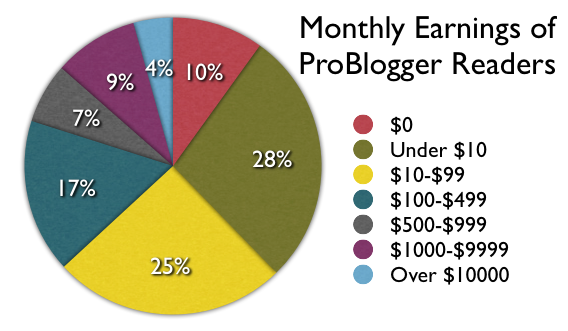
In a recent survey of 1500 ProBlogger readers we asked about their monthly earnings. What you’re seeing below is the spread of earnings from readers who are attempting to make money blogging (note: not all ProBlogger readers attempt to make money, so not all are included in these results).

Keep in mind that ProBlogger readers are generally newish bloggers—about half of those who took this survey had been blogging for less than two years.
So of those trying to make money blogging, 10% don’t make anything and 28% are making less than 30 cents per day. A total of 63% make less than $3.50 per day.
Let’s be clear—most bloggers who are attempting to make money are not making a living from blogging.
Having said that, of the 1508 bloggers surveyed 65 (4%) are making over $10,000 per month (over six figures per year) and a further 9% were doing over $1000 per month (which is at least a part-time level of income).
My feeling, having been attending blogging conferences for six or so years now, is that the number of full-time bloggers is on the rise, and there are actually quite a few more people now at least making the equivalent of a couple of days’ work a week in income from their blogs.
However, most bloggers don’t make much.

6. It takes time to build

When I dig down into the stats from the survey on income levels above, and do some analysis of those who are in the top income bracket, it is fascinating to look at how long they’ve been blogging.
85% of those in that top income bracket have been blogging for four years or more. Almost all of the others had been blogging for three or four years.
This certainly was my own experience. I blogged for a year without making money and once I started monetizing it was around two years of gradual increases before I approached a full-time income level. It would have been four years before I joined that top bracket of income (over $10,000 per month).
Blogging for money is not a get-rich-quick thing. It takes time to build an audience, to build a brand, and to build trust and a good reputation.
And of course even with four or five years of blogging behind you, there’s no guarantee of a decent income.

7. It takes a lot of work

Longevity is not the only key to a profitable blog. The other common factor that I’ve noticed in most full-time bloggers is that they are people of action.
Passivity and blogging don’t tend to go hand in hand.
Blogging as “passive income stream” is another theme that we hear in many make-money-blogging products, however it is far from my own experience.
I’ve worked harder on my business over the last ten years than I’ve worked on anything in my life before this. It is often fun and gives me energy, but it takes considerable work to create content on a daily basis, to keep abreast of what’s going on in the community, to monitor the business side of things, to create products to sell, to build an audience, and so on.
The key is to build blogs that matter to people, that are original, interesting, and helpful. But this doesn’t just happen—it takes a lot of work.

Conclusions

Yes, it is possible to make money blogging. There is an ever-increasing number of people making money from blogging at a part-time to full-time level —however they are still in the minority.
Those who do make a living from blogging come from a wide range of niches, however one of the most common factors between them is that they’ve been at it for a while.
To help you on your way to make money blogging (or make more money blogging!), don’t miss my special tenth anniversary sale, which is running right now, and which lets you get any of my ebooks for just $10.
How long have you been blogging? Are you looking to make money from it—and have you already? Share your experiences with us in the comments.

by

The Value of Comments to a Profit-making Blog


We’ve talked about the issues of blog comments before on Problogger.net, but never from a point of view of profit-making.

CoinsBut as I was looking at the stats on dPS last week, I found that this short, helpful opinion post from 2010 was still attracting a steady stream of readers—and comments. I explained on Google+ why I think that post’s still so popular, but today I wanted to look a bit more closely at how comments can help a profit-making blogger.So let’s step through some of the ways blog comments can—directly and indirectly—add to your bottom line.


Increased ad revenue

Posts that engage readers are more likely to be shared, which draws more traffic back to those posts. Commenting is a very strong kind of engagement. That lenses post really does stimulate discussion, and at the same time it’s very helpful to those trying to work out which lenses to buy.
So if someone comments on that post, they may also be more likely to share it, which would boost traffic and ad impressions. And if your blog has a “most commented” or “most popular” list in the sidebar, an ongoing comment stream could push the post into that as well, drawing more attention to it from users on other pages of your blog.

Ongoing affiliate revenue

Imagine if this post had included affiliate links to actual products. So long as I’d kept the links up to date, I could still be making affiliate revenue from a post we’d published nearly three years ago. Not bad!

Potential sponsorship

This post obviously draws strong attention from my readers. It’s been shared on Facebook nearly 1,000 times, and pinned to Pinterest more than 17,000 times.
This could give me good reason to approach brands that make the types of lenses covered in that post, or mentioned by users in the comments themselves. I could contact them to see if they’re interested in buying paid sponsorship either for that post, or an updated version of it.

Audience research for new products

The comments on the post are really insightful. Have a read and you’ll get a feel for the experience levels of the users, what brands they prefer, what they’re shooting, how they use their equipment, and so on. They’re also tagged by date, so they provide some insight into the way my audience has evolved over time.
By spending a little time going through these comments, I might easily come up with a couple of ideas for new products to try with my readers.

Encourage first-timers to engage

There’s nothing worse than clicking through from a search result to find the article you’ve chosen is old and outdated.
Comments really do keep your evergreen content fresh and alive. This is a short post, but the scroll bar indicates there’s a lot more on the page. Any new visitor who scrolled down would likely be surprised by the number of comments, and the fact that the discussion is ongoing.
They might be encouraged to comment themselves, or at least to look around the site a bit more. Best-case scenario? They subscribe to the RSS feed or mailing list, prompted by the strong evidence of a passionate readership, as indicated by these comments!
In short, comments:
  • attract attention
  • keep the discussion growing
  • are helpful to other users
  • can solicit on-site engagement in a range of ways
  • can excite users to share, driving more traffic to the post.
But there’s a catch: not all comments are good comments—especially for those with a profit focus. So let’s look at the characteristics of comments that will help you achieve the goals we’ve just talked about.

Good comment, bad comment

The kinds of comments I want to keep on my posts are those that:
  • add to the discussion, rather than just repeating the article’s main points
  • contribute insight or personal experience
  • are clearly written
  • have a username, email address, website or avatar attached.
These are the kinds of comments that potential post-sponsors will want to see, as will any advertisers or others who are considering investing marketing budget into your blog.
The kinds of comments I try to catch before they’re published are those which:
  • criticize without contribution: I love respectful disagreements in comments, because often they’re a great way to learn. But criticism that doesn’t add value is usually pretty unhelpful.
  • aren’t clear, or don’t take the post or author seriously: Again, this doesn’t really add value to the discussion. it certainly won’t inspire potential ad-space buyers about your readership.
  • simply promote their own products: Sometimes, this can be a fine line, but if a commenter simply suggests readers look at his or her own site, and doesn’t add to the discussion in any other way, I tend to send their post to the trash.
On that basis, I don’t necessarily delete comments that:
  • include offsite links
  • talk about other (or the commenter’s own) products
  • criticize or disagree with the author
  • are short or informal.
If I did that, the comments could end up feeling fairly stilted and contrived—and that’s not going to encourage further comments over time. But also, the presence of any of those things doesn’t mean the comment’s no good. Each comment really does need to be judged on its own merits, and in the context of the post and other comments that haven been made.
Taken with the post itself, the comments should ideally provide real value that encourages sharing, bookmarking, repeat visits, and more commenting—that’s where the greatest profit potential for comments lies.
Do you treat comments as adding to the overall monetization potential of your blog? I’d love to hear your thoughts in the comments.

by

5 Ways You Can Become A Blogging Philanthropist


This guest post is by Stephen Pepper of Youth Workin’ It
Why should Bill Gates have all the fun?—Al Andrews
There are all sorts of reasons you may own a blog—to enhance your business site, to share ideas, to earn an income, or perhaps you just enjoy writing.
Imagine the impact you could have, though, if you harnessed the power of your blog to make an even bigger difference to mankind by becoming a philanthropist.
This may sound far-fetched, but it’s not at all. Here are five ways you can become a blogging philanthropist.

1. Write a book

“How can I be a philanthropist if I have no money?”
This is the question Al Andrews asked himself. Instead of just giving up, he came up with a plan to make money. He’d write a book and donate the profits to projects around the world.
And thus, Improbable Philanthropy was born. His first book, The Boy, The Kite And The Wind, has already raised tens of thousands of dollars that he’s been able to donate to projects that benefit others.

What can you do?

You don’t have to write an illustrated children’s book. Many blogs sell ebooks, so why not write one whose profits you can donate to a charity that’s close to your heart? The readers of your blog will be more likely to buy the book if they know it’s going towards a good cause. And it means you’ll get your ideas out to more people, even if you’re not benefiting monetarily yourself.

2. Microfinance

Adam McLane and Rachel Rodgers are both bloggers who also own their own businesses. Adam owns McLane Creative, a web development and design company, while Rachel owns Rachel Rodgers Law, a virtual law office.
Both Adam and Rachel offer microfinance loans through Kiva. These loans are used to help alleviate poverty and to enable entrepreneurs around the world to start up their own businesses.
Adam also makes a new loan for every new client he receives—check out some of the beneficiarieshere.

What can you do?

Although Adam and Rachel offer these loans as an extension of their businesses rather than their blogs, that doesn’t have to be the case. How about making a loan every time you receive x number of new email subscribers, or when you hit a benchmark of y extra monthly visitors?

3. Invest in others

At the 2012 World Domination Summit, Chris Guillebeau gave $100 to every single paid conference attendee.
Why? He was investing the money in the attendees so that they could in turn invest the money themselves, whether that was through community, adventure, or service.
As Chris said, “Freely receive, freely give.”

What can you do?

Don’t worry, I’m not saying you have to give $100 to each of your readers! Instead, you could set aside some money and have your readers decide on how it should be used.
Similarly, you could allocate a certain percentage of each ebook you sell to be donated to different charities. When selling the book, offer the buyers different purchasing links depending on which project they’d like to support.

4. Leverage your readership

You may not have any money, but chances are some of your readers do. On his Stuff Christians Like blog, Jon Acuff set out to leverage his readership by raising $30,000 to build a kindergarten in Vietnam. The only thing is, he didn’t raise $30,000.
He raised $60,000. So his readers were able to build two kindergartens!

What can you do?

Set up a fundraiser, ideally for a project that has some kind of link to your blogging niche. This will encourage your readers to support the initiative.
Also, be ambitious! Jon’s readers raised the original $30,000 in just 18 hours, which is why he set a second target that doubled the original amount. Even if you don’t meet your fundraising target, you’ll hopefully raise far more than if you’d set the bar too low.

5. Advertising and affiliate schemes

In addition to Youth Workin’ It, we own a number of other (non-blog) websites. These earn a somewhat modest income of a few hundred dollars a month through AdSense, Amazon Associates and similar affiliate schemes.
As my wife and I both have full-time jobs, this income is a bonus. It therefore means we’re able to use some of this extra money to bless individuals and organizations that we wouldn’t have been able to otherwise.

What can you do?

Do you earn any revenue through your blog via advertising or affiliate schemes? If so, why not use some or all of this income to make a difference in the lives of others?

How will you become a blogging philanthropist?

There are five ideas on this list. What others can you think of that can help other bloggers become philanthropists? We’d love to hear your thoughts in the comments below.
Stephen Pepper is insurance administrator by day, youth worker & blogger by night. He and his wife run Youth Workin’ It which includes a youth work and youth ministry blog. They also produce their own youth work resources, the most recent of which is 52 Scavenger Hunt Ideas.

by

How Sponsored Posts Can Ruin Your Blog


This guest post is by Kalen Smith of OnlineRookies.com.

More bloggers accept guest posts for their sites.
Guest posts are an arrangement where a guest author will write content and submit it to the blog. In exchange, the blogger will allow the blogger at least one backlink to promote their own website. Guest blogging is a great opportunity for both the blogger and the guest author to receive exposure and share ideas.
Or is it? Some use guest blogging as a means to monetize their site: they charge a fee to guest authors for sponsored posts.

What is a sponsored post?

Most bloggers are more than happy to receive free content to their site and offer a backlink in return. A blogger will not generally pay nor receive money for a traditional guest post. However, some bloggers insist on taking sponsored posts instead.
A “sponsored post” differs from a traditional guest post in that the blogger will require the guest author to pay a fee to post the content. They see guest posts as a way to make money blogging.
I generally discourage bloggers from using these kinds of sponsored posts for several reasons. I think they are unfair to the guest author and can damage your site. I suggest you pursue other advertising strategies if you are looking for a way to monetize your site.
Let’s see why.

Why do bloggers take sponsored posts?

I don’t blame bloggers who are frustrated with guests who submit low quality content. Many SEO linkbuilders certainly fall into this demographic.
Some SEO companies do a very good job guest posting. One of the SEO companies I’ve worked with actually secured a guest post with one of the biggest social media managers in the world, because they were committed to quality.
However, there are other SEO companies that do a very shoddy job with their services. Although I want to encourage bloggers to be open to anyone offering a guest post, I certainly understand and respect their decision not to take a guest post from freelance writer or business they aren’t familiar with.
What concerns me is bloggers who insist on taking a payment from authors wanting to secure a spot in their blog’s schedule. These bloggers clearly aren’t discouraging what they consider “thin content” from being submitted as a guest post. They are simply using guest posts as a means to monetize their sites.
I am opposed to this as matter of principle, but it can also ruin your site in a couple of ways.

What harm can sponsored posts do?

I have a few qualms with sponsored posts. If you are offering sponsored guest posts, I ask that you at least hear me out here.

They’re unfair to the guest

Many bloggers charge a fee because they want to receive something from a guest blogger. They don’t realize they are already getting something: fresh content for their blog.
A guest poster has to spend time writing the content that they are going to submit. Warn any guest poster of your standards beforehand so they don’t waste your, or their, time. If they take their work seriously, they will submit a high-quality post to you.
As a blogger, you understand how long it takes to write great content. By accepting guest posts, you get several hundred words of great content and a fresh perspective for your readers. This can save you a considerable amount of time writing content yourself.
In return, they get a two-sentence biography and a link back to their own website. It is still a great arrangement for both parties, but you are already getting the better deal for the amount of work involved. Is it really fair to ask for a payment on top of that?
Most bloggers who charge a fee to place sponsored posts do so arguing that these posts are “advertising.” However, they stipulate that sponsored posts cannot be promotional in any way. I find this to be ironic and very unfair to the guest blogger. If a business is paying for promotion (sometimes to the tune of $250 for a post), shouldn’t they have a chance to promote their company somewhere in the post?
I can understand charging for a post that is specifically written to promote the company. However, guest blogging was intended to be more of a bartering system.

They can hurt your relationship with readers

I don’t have a problem with affiliate marketing or any other business model that makes money from great content. You can build affiliate links into your content naturally without compromising the value of your post. Affiliate marketers still focus on creating great content and share resources that benefit their readers. Sponsored posts are a bit more awkward.
Your readers could actually be offended to see you running guest posts. Why? If I see a blog taking sponsored posts, I assume that they are relaxing the standards of quality to make a buck. I am sure other readers feel the same way when they see that they are reading a “sponsored” or “paid” post. You may argue that you only take high-quality content on your site. However, I don’t believe most bloggers hold companies and SEO freelancers to the same standard when they are paying for the post.
The United States Federal Trade Commission requires you to disclose whether or not have received payment to post any promotional content or links. Other countries may have similar laws. If you are abiding by these laws, then your readers will know that you are getting paid for these posts.
Many bloggers argue that they need to generate advertising revenue. I understand that we need to make a living. But is the content itself the right way to advertise?

You are selling links

Many people who take sponsored posts claim they are against black-hat tactics such as selling links. Frankly, I don’t really care if someone wants to sell links or not. It’s not usually illegal and it’s not hurting anyone.
However, you should at least be honest with yourself. I roll my eyes when someone pretends they are superior to anyone who sells links but then turns around does the same thing themselves.
Of course, my personal opinion shouldn’t concern you. There are bigger implications, such as the fact that selling links can harm your blog’s ranking. No matter how many times you tell yourself you aren’t in the link trade business, Google will probably decide otherwise if they know you are taking dofollow, sponsored posts. In fact, Matt Cuts has written on this very topic in his article Paid Posts Should Not Pass Pagerank.
Anyone who knows you take money for guest post placement can report you to Google (including a guest blogger who was irritated that you asked for payment). Google itself can find out how much sites are charging for post placements. Matt Cutts said that Google did a small test and found a number of sites that were running sponsored post contests. Those sites are now on Google’s naughty list.
Of course, you can put the “nofollow” tag in a sponsored post, but what guest poster would agree to that? Commercial companies are usually interested in getting link juice.
Also, you better be honest with them if you are going to nofollow the link once they’ve paid good money for it. Withholding your intentions can get you into trouble later on—and with others besides the disgruntled author.

Is it worth it?

Taking sponsored posts can be risky. Is it really worth alienating yourself from your readers and damaging your position with the search engines in order to make a quick buck?
What are your thoughts on taking sponsored guest posts? Feel free to share your thoughts below.
Kalen Smith writes about the importance of a social media marketing plan and Internet marketing experiments and case studies on his blog OnlineRookies.com.

by

Grow Your Blog Business: The Earn-Millions-in-Your-Flip-Flops Framework [Case Study]


This guest post is by Stephan Spencer of The Art of SEO.

Former mortgage broker and digital information business expert, Susan Lassiter-Lyons built her business online, and grew it to a six-figure income in only seven months.
She attributes her amazing success to a simple framework she developed and perfected over that time.
Recently, I met with Susan and she shared with me her “$1 Million digital business blueprint”. In this post, I’m going to show you these exact, replicable steps to apply to your business. If you’re serious about growing your business online, then you will want to read what she had to say.
Although Susan’s framework won’t make you a million dollars in fifteen minutes like common scams littering the internet, it can show you the simple, proven way to make millions if you put forth the necessary effort.

$1 Million digital business blueprint

Forced to close her real estate business in November 2008 because of the mortgage meltdown, Susan launched her digital information business in January 2009 with a mere $200 in startup capital.
Susan’s ebook, Mortgage Secrets for Real Estate Investors is where it all started. Published nearly four years ago, it still makes $600-$3,000 a month in online sales.
That ebook functioned as a launch point for her business that eventually reached six figures by July 2009. Living by her three-step framework, she is now able to work part-time, with no boss, in flip-flops. Some might call that a dream job.

The framework

Now, let’s break down that three-step framework for creating an online business around your passion.

Step 1. Create

  • Create a product of your own.
  • Acquire the rights to an already created info product to sell as your own.
  • Expand to a product suite.

Step 2. Campaign

  • Start a blog about your topic.
  • Start a Facebook page about your product.
  • Buy some cheap ads on Google to promote your product.
  • Ask others who have websites and subscribers in your niche to email their list about your product.

Step 3. Convert

  • Create a simple website that tells visitors all about the features and benefits of your product.
  • Offer a simple way for them to buy and download the product.
Let’s look at each step in detail.

Create

Before you jump right into creating a product, you should first take a moment to identify your expertise.
Take an inventory of your knowledge by asking yourself these questions:
  • What do people always ask you about?
  • What have you studied extensively?
  • What do you love to do?
The answers to these questions will give you a solid idea about what to cover with your product. Once you have your topic, search Yahoo! Answers for popular FAQs within your subject area. These can form chapters in your book, audio programa, or sections in any of the products you decide to create.

Creating a product of your own

The first obvious option for you to pursue with your info product is to create one of your own.
If you feel comfortable enough, you can create an ebook like Susan did, but there are plenty of other options to choose from to suit your specific skills and abilities: you could write a real book, record an audio program, record a video program, host a teleseminar, host a webinar, or host a seminar. The possibilities are endless.

Acquiring the rights to an already created info product to sell as your own

Most people don’t know this, but there are literally thousands of info products available through private label rights.
If you are having trouble creating a product of your own, this is a fast, relatively cheap way to start a digital business. Through websites like NicheEmpires.com you can browse through pages of private label rights products that you can edit and make your own.
These PLR products are available for around $67! Why reinvent the wheel if you don’t have to?

Expanding to a product suite

Once you have your expertise figured out and entry-level product created, its time to expand that into an entire sales funnel to maximize your potential revenue from customers.
There are five elements to a proper product suite. Susan likes to explain these through an example of a golf information product suite.
  • Front-end product: This is the first product you develop. It should be cheap and broad, yet enticing. For example, an ebook titled How to Add 120 Yards to Your Drive, priced at $37.
  • Mid-tier program: A moderately priced product that acts as the next step in expanding the customer’s knowledge about that topic. For example, a quick video course on pitching and putting priced at $200-$300.
  • High-ticket program: A high-priced product that would include all the knowledge you have to offer on the topic covered. For example, the “Ultimate Golf Package Extraordinaire” covering everything you want to know about golf, priced at $2,000.
  • Seminar: A live event with added bonuses, where you can sell your existing products and coaching program to qualified leads. This might take the form of a “Learn from the Pros” live event priced at $1,000 at the door.
  • Coaching program: An option for those that want even more than what your products offer. This can be priced as high as you value your time. Basically, we’re talking about one-on-one personalized training here.
The most important element of this product suite is the front-end product. Once you have the customer hooked, it becomes exponentially easier to sell them your follow up products.

Campaign

Start a blog about your topic

Susan started her blog, TheInvestorInsights.com. She identified her expertise (in this case, real estate investing) and created a forum where she could post and comment on current events and issues gripping the industry.
Through consistent posting she was able to foster a community of active discussions and engaged bloggers who were interested in what she had to say. These bloggers in essence became leads for her informational products, which she was able to effectively sell through this medium.

Start a Facebook page about your product

Word of mouth is by far the best form of promotion. When somebody likes your product, you want him or her to recommend it to his or her friends. A Facebook page can help you accomplish this.
If a person is particularly pleased with your product, they will like your page on Facebook, which will notify their friends. People view the opinions of their friends as much more credible than a traditional sales pitch.

Buy some cheap ads on Google to promote your product

Google offers the most targeted advertisements on the Internet. You can choose from various demographics, including location, and purchase keywords that you believe your target customer is searching for.
In addition, Google allows you to operate on a cost per click basis so that you can control your own budget and make sure you aren’t spending too much or too little.

Ask others in your niche to tell their list about your product

Identify third parties that deal with the same topics as your products. Then offer them a deal that if they will agree to email their subscriber list about your product, you will split the revenue generated with them. For example, you could split the revenue 50/50 with a website that mentions you in their weekly electronic newsletter.
How can a company not be excited about this? All they would have to do is mention your website, blog, or product, and they have the potential to generate income. They can’t lose.
This is definitely a tactic to try.

Convert

Create a simple website that explains the features and benefits of your product

Create a sales page. Make sure it has an intriguing video that explains the features and benefits of your product in a way that inspires the visitor to sign up for your newsletter or buy your product.

Offer a simple way for them to buy and download the product

Use Clickbank or PayPal to make it easy for the customer to purchase your product in one step.
Include an Add to cart button directly under your sales video so the customer can proceed to the checkout without jumping through any hoops.

Is it really that simple?

Susan Lassiter-Lyons has proven that these steps work. While the framework is simple, as you can see, there’s a lot of work in each step. But if you follow her example, while you may not make six figures in seven months, you will put yourself on a path to similar success.
Stephan Spencer is co-author of The Art of SEO (O’Reilly 2009), now in its second edition (March 2012), and author of Google Power Search (O’Reilly 2011). He is the inventor of GravityStream, the automated pay-for-performance natural search technology platform, and the founder of SEO agency Netconcepts. He is a Senior Contributor to Practical Ecommerce and MarketingProfs.com, and a columnist for Search Engine Land and Multichannel Merchan.

by

Make Money From a Low-traffic Blog [Case Study]


This guest post is by Nathan Barry of Designing Web Applications.

It seems like every day you read a story about a blogger who released a product to their audience and made a ton of money overnight. But then after you read more details about their story, you learn that they already had a popular blog with a huge audience.
That’s the point in the process where I always used to feel disappointed. While I wanted to replicate their success, I didn’t have an audience.
My story is different. Yes, I managed to pull off a massively successful product launch, but I did it with a tiny audience. I hope this is a story you can relate to and learn from.

The beginnings

In June 2012, I had 100 RSS subscribers for my blog. Not 10,000, just 100. And I’d been working steadily on my blog, pushing everyone to subscribe by RSS, for over a year. Not great results.
But a few months later, on September 4th, I released my first product, an ebook called The App Design Handbook, which went on to make $12,000 on launch day and has passed $35,000 in total sales.
Now are you interested?

Focus on a big goal

What happened in those three months between June and the September launch? The biggest change I made was focus. Since I was working on the book I decided that my blog was going to be almost entirely focused on the topic of designing iPhone and iPad applications. So I started writing posts and tutorials that would be valuable to that audience.
I was hardly the first person to write tutorials about designing apps. In fact, there were many much more popular blogs out there. But I was one of the first to write an ebook on the subject. So when people came to my site and saw that I was working on The App Design Handbook, it gave me instant credibility.
Focusing on a big goal, in my case writing a book, will give you credibility and a reason for visitors to follow your progress.

Give people a way to follow along

At the bottom of each post I wrote from then on, I placed an email signup form for the book. It didn’t provide much information (it would have been better had I provided more), but I did give people a chance to hear about the book when it launched.
This list gradually grew to 795 subscribers by the time I released the book.
Watching this list grow gave me the confidence that my methods were working and encouraged me to keep writing posts on designing iOS apps.
It is really important that you give your readers a way to opt in and let you know they are interested in your work. I’ve found email to be the best way to do this.

Share valuable content

The posts I wrote were all tutorials about designing and coding better products. Nothing super-elaborate, just what I thought would be helpful to someone learning about design. My most popular post was titled “User Experience Lessons from the New Facebook iOS App.”
Facebook’s iOS application had been notorious for its mediocre user experience and slow speeds. So when Facebook released a new version, I took the opportunity to dissect all the design changes they made to see what I could learn. The designers at Facebook didn’t change anything major, but they made a lot of minor improvements that designers everywhere could learn from.
I hoped this post would do well on sites like Reddit and Hacker News, but it didn’t really get any traction. To my surprise, though, it started getting shared on Twitter. After three days, it had been tweeted and retweeted over 100 times, driving a lot of traffic.
More importantly, that drove a lot of email signups to my book list.

Create a good product

It would be a waste to spend months building up to a brilliant product launch, only to have a poor product. So, I spent most of my time in those three months actually working on the book itself.
It’s important to do the marketing and promotion posts (that’s the part most people ignore), but you still need to write the book or meet your larger goal.
Yet, like all things, it’s a balance. If you focus 100% of your attention on the product, you won’t sell any copies. So find the right balance between creating the product and marketing the product. I find my time is split 50/50.

The launch event

Some people say you should let people pre-order the product to test demand. While I really like this idea, I didn’t do it. I decided that the email list was enough validation that there was a demand from the market, and I wanted to create a lot of buzz by focusing everything to the launch day.
While this strategy turned out fine for me, I don’t know enough to make a recommendation one way or the other.
I do know that if you can make a big splash, a single-day launch can help sales.

Guest posts

Speaking of a big splash, I did some guest posting as well. My original goal was to have between 15 and 20 guest posts all go live on launch day. I didn’t even make it close! But five really solid posts went live on some great sites on September 4th, with one more the next day.
It just goes to show that if you set high goals, even your failures are still a small success.
None of these posts drove a lot of traffic, but I think they helped remind people about the book. That’s why I love a single-day launch event. The first time someone mentions a book on Twitter you may not pay any attention. But then if you see an article by the same author on one of your favorite blogs, the two impressions together may be enough to get you to check it out.
So, do guest posts related to your product launches, but don’t expect thousands of visitors from guest posts. Guest posts are more about building relationships and name recognition than they are about driving traffic.

Using the email list

A week before launch I sent out a sample chapter and the table of contents to my pre-launch list. A few people unsubscribed, but they wouldn’t have purchased the book anyway.
It’s important to stay in contact with your email list, rather than trying to sell to them out of the blue months after they signed up. If you’ve been completely silent until asking for the sale, the common response will be, “Who are you, and how did you get my email address?” rather than them remembering who you are, that they opted in to your list, and are interested in your product.
It would have been better if I had delivered valuable content to them for a couple weeks leading up to the launch, but at least I did something. Then on launch day, everyone was expecting the sales email. I sent it out at 6:00 AM Mountain Time and had $1,000 in sales within ten minutes. For me, that was absolutely crazy! I never expected success so quickly.
That’s the power of a good email list.
The total was $12,000 in sales by the end of the first 24 hours, and $35,000 after two months, all from a blog that was visited fewer than 100 times a day a few months prior.

Wrapping it up

I hope it’s helped to you to follow my process and see how your own blog could make money, even if you aren’t popular. You need to focus on a big project, give people a way to opt in and follow along, focus on delivering value, and make a big splash on launch day.
Got it? I’m happy to answer any questions in the comments!
Nathan Barry is the author of Designing Web Applications, a complete guide to designing beautiful, easy-to-use web software. He also writes about design and business at NathanBarry.com.


by